Fence Gates for Chippewa Valley Properties
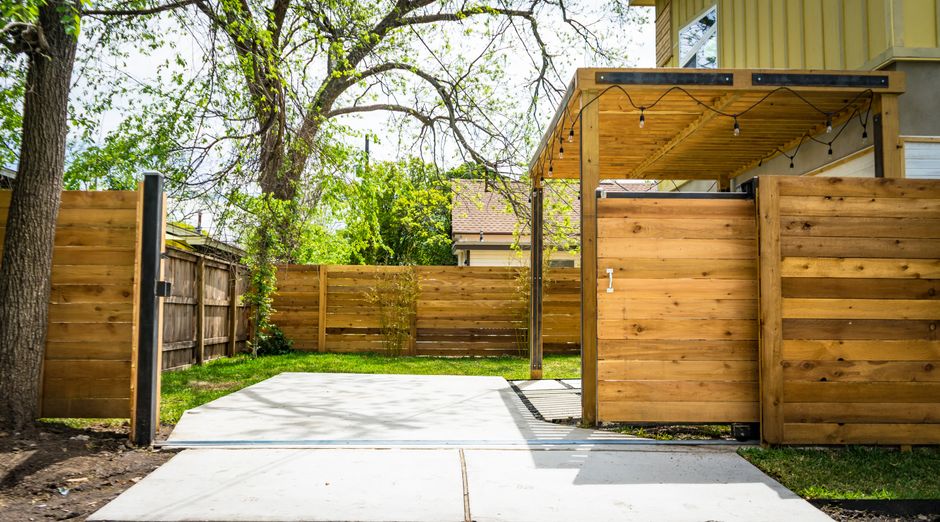
A fence is only as functional as its gates — every fence line needs at least one way through it, whether that's a pedestrian gate for foot traffic or a drive gate sized for a vehicle. Gates are also where a fence sees the most wear, since they're the only moving part, which makes gate hardware and post sizing worth getting right the first time.
Gate types
- Single drive gate — one panel swinging open across the full driveway width, the most common configuration for standard residential driveways.
- Double drive gate — two panels that swing open from the center, meeting in the middle when closed. Used on wider driveways where a single panel would be too heavy or too wide to swing cleanly, and often preferred aesthetically on a formal or ornamental fence line.
- Pedestrian gate — a narrower walk-through gate sized for foot traffic rather than a vehicle, typically placed along a side yard or front walk.
Single vs. double drive gates covers how to decide between the two drive-gate configurations based on driveway width and vehicle type.
Gate posts and hardware
Gate posts carry more load than a standard line post: a swinging gate exerts a constant cantilever force on its hinge-side post, and that force increases with gate width and weight, so gate posts are typically set larger, deeper, and in a larger concrete footing than the line posts along the rest of the fence. This is true across every fence material — wood, vinyl, aluminum, and chain link gates are all hung on posts built to handle that extra load, not the fence's standard posts.
Hinges and latches are where gate hardware quality shows up fastest, since they're the components that see repeated motion. Self-closing hinges and self-latching mechanisms are common upgrades, and most relevant around pool enclosures, where a gate that doesn't reliably close and latch on its own defeats the purpose of the enclosure. Gate hardware and latch types goes through the specific hinge and latch options and where each one makes sense.
Matching gates to fence material and style
Gates are available in the same materials as the fence line itself — wood, vinyl, aluminum, and chain link — and matching the gate's material, color, and picket or panel style to the rest of the fence is usually straightforward, since gate frames are built to accept the same infill panel. The one exception is weight: a wood or aluminum gate panel can get heavy at wider drive-gate widths, which is part of why post sizing and hinge selection matter more on a gate than anywhere else on a fence line. Matching your gate to your fence style covers how style continuity works across each material.
Automatic gate openers
Gate automation adds a motorized operator — a swing operator for hinged gates, or a slide operator for a gate that runs along a track rather than swinging — along with an access method such as a keypad, remote, sensor loop, or intercom. Automation is most often requested for drive gates on longer or more secluded driveways, where getting in and out to open a gate manually adds real friction, and less often for pedestrian gates. Are automatic gate openers worth it? covers what automation adds, what it requires (typically a power source at the gate location), and where a manual gate is still the simpler choice.
Gate width and vehicle clearance
Standard single-car driveways typically call for a single gate wide enough to clear a full-size vehicle with margin on both sides, while a double-wide driveway, RV, or farm equipment access often calls for a double drive gate instead of an oversized single panel — a single gate wide enough to span a two-car driveway gets heavy fast, which is part of why very wide openings are more often split into two swinging panels than built as one. Pedestrian gates need far less clearance, but still need enough width for someone carrying tools, a stroller, or a wheelchair to pass through comfortably.
Sliding gates as an alternative to swinging gates
Where there isn't room for a gate to swing open — a short driveway, a steep approach, or a gate positioned close to a structure — a sliding gate that rolls along a track parallel to the fence line is an alternative to a hinged swing gate. Sliding gates need a straight, level run of clear space alongside the opening equal to the gate's width, and they're more commonly paired with automation than a manual swing gate, since manually pushing a heavy sliding panel along a track is less convenient than swinging a hinged gate by hand.
Seasonal considerations for gate hardware
Gate hardware sees more repeated motion than any other part of a fence, and Wisconsin's freeze-thaw cycle adds another variable: hinges and automated gate operators both need to tolerate ice buildup, ground movement at the gate post footing, and temperature swings that can affect motor and sensor components on an automated system. This is one reason gate post footings are typically set deeper and larger than standard line-post footings — settling or heaving at a gate post throws off swing clearance and latch alignment in a way that's more noticeable than the same movement along a straight fence run.
Installation basics
Gate placement follows the same permit and setback rules as the rest of a fence line — a gate doesn't get special treatment at a vision triangle or property-line easement, and a drive gate wide enough to require its own inspection is still subject to whatever permit threshold applies in that municipality. See fence installation for the permit and height rules that apply across Eau Claire, Chippewa Falls, Altoona, and Menomonie.
Gate posts are set in concrete footings below the frost line, same as any fence post, but typically in a larger-diameter footing given the added cantilever load described above. Clearance and swing direction are also worth planning before posts go in: a drive gate needs enough clear space to swing fully open without hitting a vehicle, mailbox, or slope, and a gate swinging toward the street rather than into the yard can create its own visibility or setback issue.
Requesting a quote
Gate scope depends on gate type, width, material, and whether automation is part of the project. Call (914) 530-6133 or use the quote request process on the contact page to describe a project; that page also covers the service areas this reaches across the Chippewa Valley. A quote request carries no cost or obligation.