Wood Privacy Fence Styles Compared
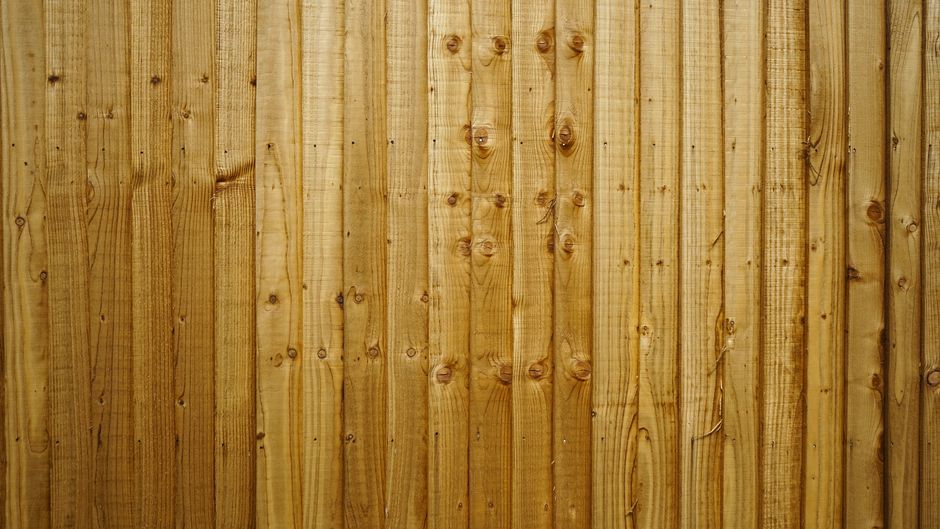
"Privacy fence" covers more than one look. Underneath that label are several distinct board patterns, each with a different balance of solid screening, airflow, cost of materials, and finished appearance on both sides of the line. Choosing between them is mostly a matter of how much visual coverage a yard needs and how the fence will be seen from the street or a neighboring lot.
The main styles at a glance
| Style | Privacy level | Wind load on panels | Typical look |
|---|---|---|---|
| Solid board (stockade) | Full — no visible gaps | Highest | Uniform, flat plane of boards |
| Board-on-board | Full, with texture | High, but staggered boards vent slightly | Shadow lines, finished on both sides |
| Shadowbox (semi-privacy) | Partial — narrow sightlines through | Lower — air passes between boards | Same look from either side |
| Framed panel with cap/trim | Full, dressed with trim detail | High | More finished, "built" appearance |
Solid board (stockade) fencing
Solid board fencing sets flat boards edge-to-edge along horizontal rails, closing off the yard completely. It's the style most people picture when they think "privacy fence," and it delivers the most complete visual block for the least design complexity. Because the boards form one continuous plane, this style also catches the most wind — a real consideration on an open Chippewa Valley lot without much wind-break from trees or structures, since a solid run of panels acts almost like a wall in a gust. Posts and footings need to be sized to handle that load, which is one reason a fence this size is worth planning with a professional installer rather than treating it as a simple board-nailing project.
One tradeoff with solid board fencing: one side of the fence shows the finished face of the boards, and the other side shows the rails and posts. Most homeowners orient the finished side outward, toward the street or the neighboring yard, and keep the structural side facing their own property.
Board-on-board fencing
Board-on-board fencing overlaps two staggered rows of boards so there's no direct sightline through the fence from either side, while leaving small gaps between boards in each row. The overlap means both sides look essentially the same — no "good side" and "bad side" — which is useful on a shared property line where both neighbors want a finished appearance. It also uses roughly 30-50% more lumber than a single row of solid boards, since two overlapping layers are doing the work of one solid plane, which is a factor worth weighing against a straightforward stockade layout.
The staggered gaps also let a small amount of air pass through the fence line rather than catching it fully, which can ease wind load slightly compared to solid board while still blocking direct views.
Shadowbox (semi-privacy) fencing
Shadowbox fencing alternates boards on opposite sides of the rails with a gap between them, so the fence blocks a direct straight-on view but allows angled sightlines and airflow through the structure. It's a middle-ground choice: less absolute privacy than solid board or board-on-board, but better air circulation through a yard, a softer look from the street, and generally less lumber per linear foot. Shadowbox is a common choice for a side or rear yard where some airflow and light matter more than total visual blocking, while still reading as a "privacy style" fence rather than an open picket design.
Like board-on-board, shadowbox looks the same from both sides, since neither side has an unbroken run of board faces.
Framed panels with a cap and trim
Any of the above patterns can be dressed up with a top cap rail, trim boards at the posts, or a routed or lattice-topped accent strip. These details don't change the core privacy behavior of the underlying board pattern, but they change how finished the fence looks up close — a cap rail keeps rain from sitting on exposed board end-grain along the top edge, and trim at the posts gives the fence a more built, less utilitarian silhouette. For a front-facing section of yard, or anywhere the fence is a visible part of the property's curb appeal, these details tend to matter more than they do along a back property line.
Choosing between styles for a Chippewa Valley yard
A few practical questions tend to settle the choice:
- Is the fence on a shared line with a neighbor, or a solo boundary? Board-on-board or shadowbox avoid the "good side/bad side" issue on a shared line.
- Is the lot exposed to open wind, or sheltered by trees and structures? Solid board catches the most wind; shadowbox catches the least.
- Is total visual blocking the priority, or is some airflow and light welcome? Solid board and board-on-board block fully; shadowbox trades some privacy for ventilation.
- Will the fence be seen from the street? A framed panel with a cap adds a more finished look where appearance carries more weight.
None of these styles is objectively "better" — they solve different combinations of privacy, airflow, and appearance, and the right one depends on the specific yard.
Working with a fence installer
Board pattern is only one part of a privacy fence's performance. Post spacing, footing depth, and rail placement all affect how well any of these styles holds up to wind and seasonal ground movement over time, and those details are easier to get right with an experienced installer than to work out from general guidance. For more on the installation process itself, material options, and what to expect before requesting a quote, see wood fence installation.